On-Device Underwater Fish Detection: A New Benchmark and Distillation Framework Baseline
Abstract
Underwater fish detection demands high precision and real-time processing amidst severe challenges like morphological deformations, dense occlusions, and fast swimming speeds. However, deployment on resource-constrained edge devices (e.g., underwater cameras) is hindered by two coupled issues: underwater turbidity, backscatter, and color distortion degrade visual features, while mostly static benchmarks fail to evaluate temporal deformation, occlusion changes, and instance continuity. To tackle these issues, a novel Dual-Stream Spatio-Topological Distillation (DSTD) framework is proposed. It features a Tri-Hierarchical Spatial Feature Alignment (TSFA) module to suppress background noise via mask-guided partitioning, and a Tri-Perspective Topological Relation Alignment (TTRA) module to capture structural relationships across intra-class, inter-class, and temporal dimensions. Furthermore, we introduce the UW-Fish-100 benchmark, comprising 16,649 frames across 10 aquatic scenarios with strict temporal instance annotations. Experiments show DSTD significantly outperforms state-of-the-art distillation methods. The distilled model improves the student baseline accuracy while preserving real-time inference (36.94 FPS) on a standard edge AI processor. Code and benchmark dataset will be released at https://github.com/vision4robotics/DSTD.
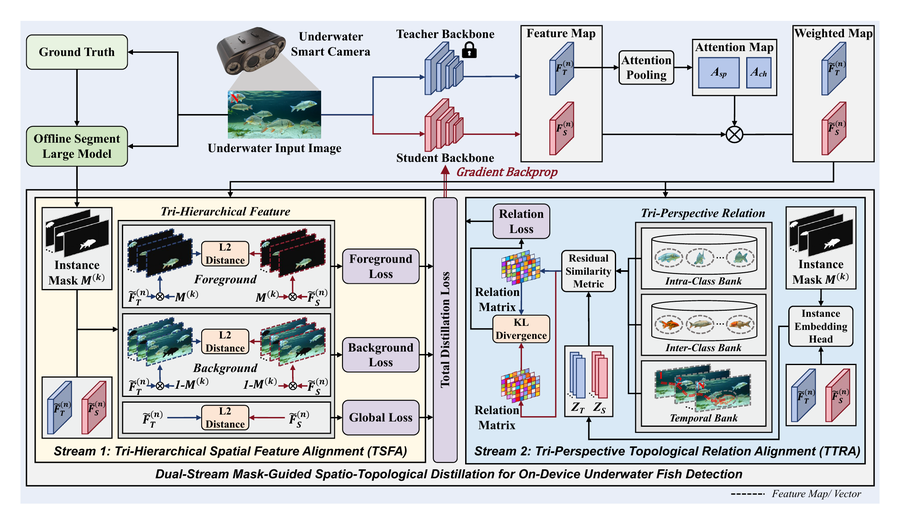 Overview of the DSTD.